Under a darkening sky, a conversation

wp_000622

By Warwick McFadyen

A park bench on a dull summer morning. Friends Rosencrantz and Guildenstern are debating the merits of apples and oranges when talk is diverted to the politics of entitlement.

Rosencrantz:  Well you know Guildenstern if it were not for the apple there would be no gravity. It was an apple that landed on Isaac Newton’s head, thus allowing him to think up gravity, which is a very useful thing to have. Without it who knows where any of us would be.

Guildenstern: Rosencrantz, even by your standards, that is one of the silliest things ever to have come out of your mind and mouth. It could just as easily have been an orange that fell on Newton’s head, which would have proven gravity exists. The substance of the object has nothing to do with it. Indeed, the fact of gravity would still be whatever the alternative.

Rosencrantz: You’re entitled to your opinion my friend and I’ll stick to mine. Speaking of entitlements, I read yesterday that we are living in the Age of Entitlement. Did you know that?

 Guildenstern: I did not.

Rosencrantz:  We are. Well you and I aren’t and, strictly speaking 99 per cent of the world is not, but that other 1 per cent, it is for them a glorious time.

Guildenstern: But doesn’t everyone live in the one age? You can’t transport yourself out of an age. We are not time travellers quite yet, so isn’t the Age of Entitlement upon us, too? I must admit I can’t feel it falling over my shoulders, but if it is there then we must be part of it.

Rosencrantz:  There’s a logic to your thoughts that unfortunately for you, and me, doesn’t align with the new stars in the heavens.

Guildenstern: But aren’t the stars steadfast and true?

Rosencrantz: Not in this age my friend. You think you know what the truth is, such as the shape and path of the sun, moon and stars, and then someone comes up with an alternative version. It’s quite remarkable how easily it is done.

 Guildenstern: But people surely can’t be fooled by this?

Rosencrantz: Ah people . . . People follow whatever they think will lead them to the promised land. It only takes an appealing message said repeatedly to win them over.

Guildenstern: Surely, it is more than that.

Rosencrantz: Perhaps, but not much more. It’s the Stockholm Syndrome writ large. The followers are really hostage not to kidnappers, but to a different kind of fortune they can see will be within their grasp. The foolish thing is they think they are winners.

Guildenstern: And they have to think that because they have been losers so to think otherwise would be to reduce their lives and the meaning of their lives to nothing.

Rosencrantz: Yes. They are looking for salvation, from a point of anger. And the only way they think they are going to find it is to have faith in someone, anyone – could be a card sharp, could be a television host, could be a monkey – who says I am one with your anger and resentment. I am going to tear down your walls. Your enemies are mine. I will fight for you. I will purify our homeland.

Guildenstern: It’s just as well we have a park bench to call home in these times. At least we can’t be deported. You are a Christian aren’t you, Rosencrantz?

Rosencrantz:  Actually Guildenstern, I’m agnostic. I’m too afraid to decide which team to barrack for. I mean, what if it’s the wrong one?

Guildenstern:  Wise choice. If anyone asks, we can both say the same. None of the religions are pure of bloodshed and tyranny, but just now love Jesus if anyone asks. Oh, and love flag and country. But do not love refugees. If anyone comes to our bench asking for help, directions, food or water, tell them to go back to where they came from. Ignoring them isn’t enough.

Rosencrantz:  OK. I must say for an Age of Entitlement it all sounds very severe. It doesn’t feel right Guildenstern. We would never say that to anyone. We’ve always shared our bench, knowledge such as it is, and food, meagre as it is, with any who asks.

Guildenstern: Yes, but we’re living in a new age. Those people aren’t entitled to it, friend.

 Rosencrantz: Then who is?

 Guildenstern: Those with the power, which we gave them through our system, to decide for us, who shall be entitled.

Rosencrantz: We place a lot of trust in them to do the right thing don’t we?

Guildenstern:  Yes, but that’s democracy. As to the right thing. Ha, that’s like Newton’s gravity and the apple and the orange. What you and I see as the right thing, such as helping refugees, might be the wrong thing to another.

 Rosencrantz: Yes. But aren’t some things beyond dispute? Otherwise the universe would be full of alternative facts. It would explode from people and events crashing into each other.

Guildenstern: Ah my friend, here’s the sad and depressing thing, some people can live with the big lie. They don’t see it as a refuge from the truth. They see it as a way to entitlement.

Rosencrantz: Yes, I agree. (turning to one side), Guildenstern, is that a raggedy-looking man coming towards us?

Guildenstern:  It is. Make room. I’ll fetch some water.

Warwick McFadyen is a freelance writer and editor

Street terror

bourke-street-mall-40009


By Warwick McFadyen

This is how slender life is. It is a walk along Elizabeth Street in the city. It is crossing the Bourke St Mall. It is being simply in the wrong place at the wrong time. It is bad luck. It is tragedy wrapped in the daily humdrum of ordinary things, of doing ordinary things among the habits and routines of a life.

They could not see what was going to happen on Friday afternoon in Melbourne as it careered towards them. They could not prevent it. They were defenceless. It was merciless in its consequences; a vicious sideswipe of cosmic, lethal dimensions.

People were going out their business, as I was with my son, in the city just an hour or so before. Everyone dies, but no one deserves to die like this. Three have, one just a baby. Scores have been injured. Four children are critical in hospital.

It took just a man and a car. Not a bomb, not a machinegun. A man in a car. This is the cruelty of the incomprehensible.

This is not terrorism come to wreak devastation and death upon an enemy. This is not Nice last Bastille Day when a truck was deliberately driven along a promenade killing 86 people and maiming more than 400. The driver Mohamed Lahouaiej-Bouhlel was known to police but not for his radicalism. Islamic State will not claim responsibility for Friday’s outrage.

In Melbourne, this driver was on the radar. Said police commissioner Graeme Ashton: ‘‘What we do know of the person is there is an extensive family violence history involved. He has come to our attention on many occasions in the past. We have mental health and drug-related issues in the background of this particular person.

“He has been coming to our attention more recently over recent days in relation to assaults, family violence-related assaults.”

What no one could know is the trajectory his past and present would fashion into the actions on Friday. There was simply no radar. This is different to deadly catastrophes of nature, such as the avalanche in Italy where a hotel was buried under snow and 30 people are missing, presumed dead. The guests had been waiting to leave. Now they truly are the departed.

Tonight, families and friends are sitting and standing in vigil by a man, woman or child, willing life to remain in their bodies. Some, tragically, are breathing in the silence, walking in the spaces, where a life used to be.

It only took a short moment of madness to cut the cord. This is terror drained of reason, baseless of belief, ideology or sense. This was death as a sliver that ripped through the surface of an ordinary Melbourne day.

This is not what Emily Dickson meant when she wrote:

Because I could not stop for death/He kindly stopped for me.

There is no rhyme nor reason that can bring solace to this grief. Death, a companion to us all eventually came as a stranger to strangers. It’s not fair. It’s beyond heartbreak.

The dead and the injured were innocent victims of a driver and a car.

When the police investigations are completed, and the matter processed by the courts, the hollowing in certainty, of safety, with which we all need to function, will remain, a slight indentation in some, a gouging in others. This is the start of a terror. And yet life go on, for how could we not refuse to go on living? This is also a terror – to move, as one always has, beyond.

Warwick McFadyen is a freelance writer and editor

Stevo

australian-flag

By Warwick McFadyen

Fuck this. No. Here we go. Not again.

And that’s how Stevo’s day began. With such a thought. He was watching an early morning TV show. Bloozie and Blousie and Greta and Sacha were smiling at him, and one was telling him how it was possible, according to the latest research, to be happy and fulfilled even when you have had an impossibly awful day. You all know, they beamed, the soy café latte is lukewarm when it arrives, the cleaner is sick, sick! and can’t do the house today, your hairdresser has been in a car crash and won’t be available, depending on the x-rays, for at least a couple of days. Horrendous.

Yeah, Stevo thought, eyelids half-raised to the TV, that’s my life.  The bloke on screen nodded, threw in a quirky observation about the meaning of everything, and turned to face the side camera, the one with the lens on the other side of life. The bloke was yabbering on about Afghanistan or Iraq or Yemen or Syria or Palestine or Somalia or Sudan or Getfuckistan, thought Stevo, and how our good, honest, and trueblue diggers were getting beat up for just doing their job saving the ingrates from other ingrates. And then after a moment’s patriotic pause, the camera switched back to one of the women who pronounced that war was entering the bloodstream of our country towns, too; on the main streets of Australia these unAustralians, let into the nation through bleeding-heart politicians, were taking over, building mosques so that they can gather there and pray (and here the deeper stress on the word implied to Stevo they’re not going to pray). There was a five-second quote from one of them, saying we’re peaceful and 30 seconds from a woman with a Target shopping bag in one hand and a large McDonald’s cola in the other, saying basically, that’s bullshit. She wasn’t scared, she was pissed off. There’s going to be a rally here, right here where I’m standing, she said, this Saturday morning to reclaim Orstraylya.

Stevo thought, she’s right: Fuck this. I’m going. Gotta show the flag for the country. It was lucky really that this information even came to him. The TV was still going from the night before, unlike Stevo who had stopped going sometime in the early hours and then been woken by the clang and crash of the garbage truck’s picking up of the bins and throwing them back down on the footpath. Stevo looked, lizard-eyed, around where he was. There had been others, he was sure, a couple of mates, couple of strangers. He hadn’t started off at home, but it looks like he finished here. This was definitely his sofa he was flopped out on. How much coincidence could there be in the world for there to be two sofas with the identical cig burns in the same corner? Impossible, he reckoned.

He was lying on his side, one leg and arm dangling over the edge. He wanted to move onto his back, not that the ceiling afforded a better view, or perhaps it did, he shrugged, but the lines of communication between brain and body seemed to have broken down. He’d give himself a little while to move his limbs. They had acquired a can’t be fucked lethargy all on their own, it seemed to Stevo. He’ll just wait till they come to their senses. Out of the corner of his eye he saw his dog, a border collie cross with happenstance, on the other side of the room raise its head, look at him and then display the same disposition as his limbs. Good dog, Stevo muttered.

Saturday, that’s tomorrow, isn’t it? He asked his brain. No reply. Luckily, again, the TV usefully displayed time and date. Today’s Friday, tomorrow’s Saturday. He’d be at work if he had work. Until this week, he had been a labourer on a building site. We’re building your dreams, the sign outside the houses said. We’re building your crap, Stevo knew. Still, who was he to argue if people wanted to aspire to self-mockery and spend barrowloads of money doing it. A flock of farting pigeons could blow these places down, never mind a storm. But it wasn’t a crisis of conscience over misused building regulations that led to his termination. Nah, Stevo just apprised the boss of his shortcomings, nothing serious in Stevo’s mind, a bit of verbal jousting over a level of incompetency that was fairly obvious to everyone. Still the boss didn’t like being called a professional nong de plume. He had to ask, what the hell does that mean. Then he took offence and fired him.

So Stevo had all of today to swim among his thoughts about tomorrow. He shouldn’t have. Stevo prided himself on his logical frame of mind, despite all other failings within it. Fast approaching 30, and just as rapidly acquiring a splendid trail of false starts both in work and relationships, Stevo was the ultimate transit passenger on life’s journey. This was his imagery to justify every twist of fate that had grievously befallen him.

His logic now, though straining to stay pure in a sea of beer-sodden debris, such as ragged-arse memories, seemed ineluctable. Stevo loved throwing that word around at people he knew wouldn’t have tinker’s hope in hell of understanding. In E. Luck. Ta. Bel. Phonetically speaking. It rolled off the tongue. And onto the floor. He picked it up and held it into the televisiony light. It is In. E. Luck. Ta. Bel. that their cause is right. They are Australians, therefore they want their streets and towns to be Australian. Therefore, they must fight against invasions by non-Australians. Therefore, they must stop the outsiders. I am an Australian, therefore I must join the fight.

Truth is, he also just loved an argument. He was thrown off the school debating team for arguing too much and not debating enough. No one else saw it as a blood sport. To him, this was a pity. It was the ideal evolution of war where the only weapon was the word. In. Fucking. E. Luck. Ta. Bel. And therein lay the problem. Stevo had never been able to decide whether he wanted to be an outsider or one of the crowd. This bleary morning, he wanted to be one of them, that is, one of us, that is, something other than himself. It was easy to accommodate.

As to his opponents this Saturday, clearly they were not Australian. They stopped work to pray. Every day. Australians stopped work to watch a horse race. In Melbourne, Stevo’s home city, they stopped work for the whole day to watch a horse race that only lasted three minutes. Now, that’s Australian. A mob would have to be suss who prayed every day. There really couldn’t be that much devotion required to keep their god happy. All we do, Stevo muses, is eat a slice of ham and turkey at Christmas and a bit of chocolate at Easter. Easy peasy. As for global domination, as long we’re world cup champions at something, anything, we’re doing all right. And we don’t blow things up. Nah, we just have our servants of god abuse and torture little boys, well we used to, so that they end up damaged all their lives or kill themselves. It’s the laconic method of destruction.

Stevo was a bit amazed at how he was making easy work of persuading himself to attend tomorrow’s protest, even without the likes of Lady Target going off at the foreigners or Blousie winking at him on the TV. He could see how easy it was for the pitiful to become passionate and righteous.

And then he shut his eyes. And then he opened them. It was tomorrow.

It soon became apparent to him that Tomorrowland was a very strange place. He was standing outside a pizza joint among a strip of shops and cafes that ran about 100 metres then petered out from boredom. It was the main street. At one end, Australian flags were not so much fluttering in the breeze, it seemed to Stevo, as switchblading the air, an air laden with drumbeat defiance. He looked but couldn’t see Lady Target. No matter.

At the other end were their enemy: the liberal softheads. They had posters and chants and songs, acapella, but Stevo saw that they were angry, too. They just had nicer tattoos. They were also a more mixed lot than the Rose Tattooed mob. On this point, Stevo did feel a loner. He had no tattoos, feeling that a well-inked name or motto at one time in your life may become a permanent flesh wound later.

Both camps were getting restless, creeping a little closer to the other, scampering back, raising the volume of the shouting. Pushing each’s idea of freedom a tad nearer to the other. And in the middle were the poor plods, keeping it orderly, keeping it peaceful, and resented by both. What a job, Stevo thought.

He stayed on the footpath, outside the pizza place. (It was opening soon and agitation can make a man hungry.)  But here was the thing, Stevo realised that he was feeling less and less inclined to be agitated by what the either side was shouting. From the boofhead with the megaphone standing on the back of the ute to the rainbow regatta of rage at the other end, the whole scene merged into an efflorescence of useless energy. Stevo wasn’t even hungry any more. He began to walk towards his car, which he had parked away from the main drag. Over his shoulder, he heard what could have only been a copper yell to a colleague, “Who threw that first stone? Did you see?” His mate replied: “Sorry missed it.”

Stevo got to his car and noticed for the first time that he had parked outside a church, a splendid edifice it was, too. On a whim, he walked through the gate and into the grounds, well-kept, manicured, obviously looked after. In the distance he could hear the start of a minor riot. Ah well, I can see it on the news tonight.

In the dust, just before worshippers would climb the steps the steps to the front doors, he dragged his shoe along to form a few words.

Fuck this. No. Never again.

Warwick McFadyen is a freelance writer and editor
 

Not walking away

20161215_093635-3 

By Warwick McFadyen

I walked by.

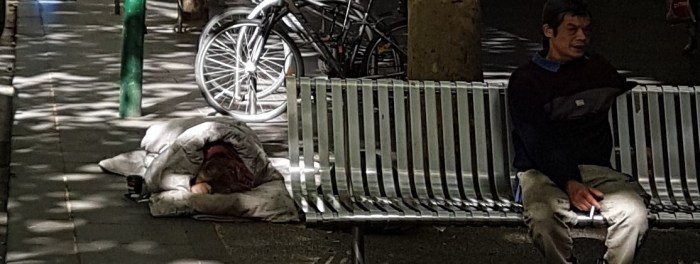
It’s not that I hadn’t noticed the human in the bag. I had seen his matted hair, a bit of a hand and the back of the neck. It wasn’t the first human in a bag I had seen that morning in the middle of the city; sorry, in the middle of the most liveable city in the world.

Welcome to Melbourne, where you can live on the streets, just like any other city in the world. But these streets are more liveable. The lucky country that’s us. No cultural cringe here. The bodies in the bags, or under blankets, or hunched over and under rags were the evidence to that.

I walked by. I wasn’t alone. Everyone walked by. Not just by this person, but all the other men and women, too. Can you judge people? After all, that is not their life in the bag. Why engage with a stranger? And a down-and-out one, presumably, at that. A few more steps and the body in the bag will be out of sight and, if not out of mind, then put to the margins of the day’s experiences, if at all archived in the memory.

Besides, the homeless in the doorways harm no one (except shopkeepers who complain it’s a bad look for business if a person sleeps in theirs).

Nationally, about 105,000 people are homeless. In Melbourne close to 250 people, on recent counts, sleep rough each night, a rise of 74 percent in two years.

It’s not that as a society we do not care. Many agencies provide help, but the rising of the tide in numbers can drown efforts and, worryingly, for the health of a society it can turn the walkers-by sympathy into resentment and indifference.

Salvation Army chief Brendan Nottle says homelessness is in crisis; Mayor Robert Doyle is scared by the numbers because, as he told The Age “behind those 247 rough sleepers are tens of thousands of people in housing distress”.

It is probable the numbers are far greater, given that a count cannot possibly cover every area. When the homeless establish camps, as occurred in the city square or at Enterprise Park near Melbourne Aquarium, then indeed there is a crisis. The state government has announced a series of measures to tackle the issue. http://tinyurl.com/gmcd6xm, as has the city council allocated money.

The gap between the two worlds of walkers and rough sleepers is accentuated at this time of year. Peace on Earth, goodwill to all. These are not hymns to the silence of the dead footpath at midnight. How many shopping days to Christmas? Rough sleepers don’t shop till they drop. Rough sleepers don’t shop. They drop where they can find a safe spot. Charities and people of goodwill try to bring into these lives for a day the spirit of Christmas.

And on the lead-up to this day, among the bustle and hubbub of a city alive to song and celebration, I walked by.

But then, a few paces on I stopped, turned around and went back – though keeping a respectful distance. But why? It seems absurd to argue that I didn’t want to invade his privacy, that I wanted to keep a respectful distance. He was asleep. I didn’t want to disturb him. Perhaps that was it. Some might say the homeless have jettisoned the consideration of respectful distance and privacy by merely being there. Some have no idea.

This man was one of the city’s many homeless residents, asleep on the footpath in the CBD in the week before Christmas. He was just centimetres from the gutter. But, here on the footpath, was still a man.

Last January I wrote a column in The Age about the homeless, beginning with a man who used to play guitar and sing in Collins Street. He had a few coins before him. It was really existential crowd funding. The full column is here: http://tinyurl.com/zgwbwas. I wrote that in essence if nothing else can be afforded then surely there is still kindness. It costs nothing.

To the man in the bag, I stopped and took the photograph that is at the top of this piece. It captures evidence of a life. When I returned an hour later, he was sitting up, shaking loose the rough sleep. It occurred to me then that the hardest battle of walking by is the giving in to indifference. For it means that you are not walking by, you are walking away.

Warwick McFadyen is a freelance editor and writer

Humanity’s (latest) meltdown: Aleppo

12-09-2016aleppohcr

By Warwick McFadyen

Home

Is not

A

Refuge.

Home is limbo. Home is the road from death and destruction to uncertain life. Home is the dust you carry in your hair and on your face from the place you have been forced to leave behind. It will seep into the skin and reside in you. It will become an idea of home – safe, stable – that you hope to one day plant somewhere else and nourish. This then is your journey: to carry refuge and ruins.

You are not alone. This much is obvious to you on the road. You can see the columns of men, women and children snaking in front of you and behind you, or heaving in and out at borders and fences. A surge that inhales and exhales, sobs and moans, stays mute and roars. And that is only what you see, feel and touch.

You are not alone. There are millions just like you. The Pew Research Centre, citing UN figures, says more than 60 million people were displaced in the world last year, that is within their country or having been taken outside its borders. One in 100 people worldwide, the highest ratio since records began in 1951. The figure is highest in the Middle East where it stands at one in 20.

In Syria, the number of displaced stands at 60 per cent of the population: more than 12 million people.

It is to Syria that death comes most prominently now. And same as it ever was, those who have no part in it, die. That is, the civilians. The innocent used to be called, with a military and political shrug, and ideological yawn, collateral damage. Now, this pretence at absolution from guilt is not even given a cursory nod. Everyone in the zone is guilty. Or worse, of no consequence. Life is without value. It is of no worth. That being so, death can be casually dispensed.

This week the United Nations called the situation in the city of Aleppo in Syria a “complete meltdown of humanity”. It had reliable evidence that in four regions in the city more than 80 civilians were executed by pro-Syrian-government forces. Thirteen were children, 11 were women.

Britain’s ambassador to the UN, Matthew Rycroft, said: “They have gone from siege to slaughter.”

Samantha Power, the US ambassador to the UN, said: ‘‘Aleppo will join the ranks of those events in world history that define modern evil, that stain our conscience decades later – Halabja, Rwanda, Srebrenica and now Aleppo.’’

Power was speaking at the UN Security Council emergency briefing on Syria on December 13.

Here are a few more extracts of her speech: “Here is what is happening right now in eastern Aleppo. Syrians trapped by the fighting are sending out their final appeals for help, or they are saying their goodbyes. A doctor named Mohammad Abu Rajab left a voice message: ‘This is a final distress call to the world. Save the lives of these children and women and old men. Save them. Nobody is left. You might not hear our voice after this.’ A photographer named Ameen Al-Halabi wrote on Facebook: ‘I am waiting to die or be captured by the Assad regime. Pray for me and always remember us.’ A teacher named Abdulkafi Al-Hamdo said: ‘I can tweet now but I might not do it forever. Please save my daughter’s life and others. This is a call from a father.’ Another doctor told a journalist: ‘Remember that there was a city called Aleppo that the world erased from the map and history.’ ”

“The Assad regime and Russia appear dead set on seizing every last square inch of Aleppo by force, no matter how many innocent bodies pile up in their wake. But we keep insisting on answering the UN call for access, for safe and orderly evacuation, because we are not willing to accept that innocent men, women, and children can be butchered simply because they happen to live in a conflict area. Our shared humanity and security demands that certain rules of war hold, the most basic. And it is up to each and every one of us here to defend those rules.”

“To the Assad regime, Russia, and Iran, your forces and proxies are carrying out these crimes. Your barrel bombs and mortars and airstrikes have allowed the militia in Aleppo to encircle tens of thousands of civilians in your ever-tightening noose. It is your noose. Three Member States of the UN contributing to a noose around civilians. It should shame you. Instead, by all appearances, it is emboldening you. You are plotting your next assault. Are you truly incapable of shame? Is there literally nothing that can shame you? Is there no act of barbarism against civilians, no execution of a child that gets under your skin, that just creeps you out a little bit? Is there nothing you will not lie about or justify?”

The full address can be read here: https://usun.state.gov/remarks/7607

Power has a deep moral investment in the massacre of the innocent. Before she was appointed UN envoy, she had written a book entitled A Problem from Hell: America and the Age of Genocide. It won the Pulitzer for non-fiction. In it she examines her country’s response to genocide in Armenia, Cambodia, Iraq, Rwanda and the Balkans.

I interviewed her about the book. She told me: “The big shocker for me… is when I realised there’s all these answers to why we don’t do enough – imperfect information, no national interests, bureaucracy being tailored in that direction, no presidential leadership, no domestic political pressure, a lack of faith in American power after Vietnam, all these reasons – a full year before publication, getting a sense of what the last draft would be like I realised literally it would be like this: ‘Oh my God, we don’t do anything about genocide because we don’t want to.’ ”

(The full piece is here: http://tinyurl.com/h476ppj).

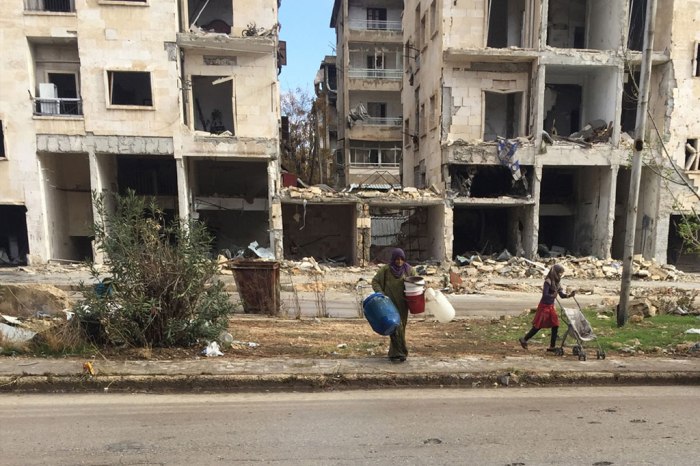
Aleppo looks much like every other city that has been bombarded into the earth in a conflict. (Except, of course, Hiroshima and Nagasaki.) It is a wasteland of rubble, and mangled metal. There is no glass in the windows. There is no form to define its encompassing structure to its residents. As its people are reduced to exiles, so its buildings are reduced to debris.

All things are relative. These numbers of displacement, death and misery are a pale shadow of that suffered in the world wars where tens of millions died, were injured or became refugees, or in subsequent conflicts such as Vietnam.

All things are relative. But.

Relativity does not equal mass acceptance. Australians are divided in how they look at those seeking asylum to these shores, even though the number is, relatively speaking, small. And we do accept people from war zones. The government said in September 2015 that it would take an extra 12,000 from Syria and Iraq. Between July last year and October this year, 14,000 visas were granted to those who had been displaced in Iraq and Syria; more than 10,000 had arrived in Australia. In 2015-16, the government granted more than 17,000 refugee and humanitarian visa, according to a report by the Department of Immigration and Border Protection.

But. Some figures are not always the answer. The preceding ones obscure a much smaller tally – that of the asylum seekers in offshore detention – that casts a much larger shadow over our continent.

This is a grotesque distortion of what should be universal: helping those who through no fault of their own are at the mercy of others, or worse, an indifferent world. Until that is resolved, how can anyone say they truly know the nature of their home?

Warwick McFadyen is a freelance writer and editor
Dylan’s reign of words

dylan2


By Warwick McFadyen

 Early Sunday morning (Australian time) a nervous Patti Smith sang, and stumbled in part, A Hard Rain’s A-Gonna Fall. She was the proxy for Bob Dylan at the award ceremony for the Nobel Prize. Dylan, well, he wasn’t there. He apologised and sent his gratitude and some words.

These are some of them and it shows that he was truly humbled and rendered speechless when the news came through. It also shows that the artist knows deep within them what they are doing because they are what they do and what they do helps creates them. It is an exercise in becoming. Others interpret, often wrongly, how they believe that art should be labelled.

Dylan wrote: “I was out on the road when I received this surprising news, and it took me more than a few minutes to properly process it. I began to think about William Shakespeare, the great literary figure. I would reckon he thought of himself as a dramatist. The thought that he was writing literature couldn’t have entered his head. His words were written for the stage. Meant to be spoken not read. When he was writing Hamlet, I’m sure he was thinking about a lot of different things: ‘Who’re the right actors for these roles?’ ‘How should this be staged?’ ‘Do I really want to set this in Denmark?’ His creative vision and ambitions were no doubt at the forefront of his mind, but there were also more mundane matters to consider and deal with. ‘Is the financing in place? ‘Are there enough good seats for my patrons?’ ‘Where am I going to get a human skull?’ I would bet that the farthest thing from Shakespeare’s mind was the question. ‘Is this literature?’

The full speech is here: http://tinyurl.com/zxfrhrv

Patti Smith told the audience: “I chose A Hard Rain because it is one of his most beautiful songs. It combines his Rimbaudian mastery of language with a deep understanding of the causes of suffering and ultimately human resilience.

“I have been following him since I was a teenager, half a century to be exact. His influence has been broad and I owe him a great debt for that. I had not anticipated singing a Bob Dylan song on December 10th, but I am very proud to be doing so and will approach the task with a sense of gratitude for having him as our distant, but present, cultural shepherd.”

Hard Rain is par exemplar of the man’s lifetime achievement.

I came to it via the double album Bob Dylan’s Greatest Hits Vol. II. It was on side 3, along with All Along the Watchtower. As a teenager I played that side to death. It was my first Dylan album. I can’t remember why it was first before the actual original albums, or even how I came to the man himself and his songs. But after Vol. II, I went backwards in time to Highway 61 Revisited, Bringing it all Back Home, Another Side of Bob Dylan, The Freewheelin’ Bob Dylan and John Wesley Harding. Hard Rain the song was on The Freewheelin’ Bob Dylan. It was in the company of greats such as Blowin’ in the Wind, Masters of War, Girl from the North Country and Don’t Think Twice It’s All Right.

Some songs go deep into a mystery made from the possibilities of words and music. They are home to echo and resonance, light and shade, they enter and reside. It’s All Right Ma (I’m only Bleeding) had the same effect at the time.

Lyrics in his hands were more than rhyming couplets. Dylan wrote songs on a typewriter. There was a bedrock of hours upon hours of reading in the lyrics. Dylan wrote in Chronicles of his devouring of works of literature in the early years in New York.

Hard Rain was poetry in motion, not spoken motion but sung motion. It had a propulsion with if not a back beat then a strumming and a thrumming of rhythm. It was an insistent building up of images that folded back and back again with the borrowing of the introductory motif: “Oh, where have you been, my blue-eyed son?/Oh, where have you been, my darling young one?”  On first hearing it Dave Van Ronk said, “I was acutely aware that it represented the beginning of an artistic revolution.”

A member of the Nobel committee, Professor Horace Engdahl, said at the ceremony in Stockholm that Dylan “panned poetry gold, whether on purpose or by accident is irrelevant … he gave back to poetry its elevated style, lost since the romantics.” His full speech is here. http://tinyurl.com/j25rds9

The genesis of Hard Rain is well-known, as Dylan said: “Every line in it is actually the start of a whole song. But when I wrote it I thought I wouldn’t have enough time alive to write all those songs so I put all I could into this one.”

This was the time of the Cuban missile crisis in October 1962 when the world was on the brink of nuclear strikes between the Soviet Union and the United States. Cuba, under Fidel Castro, had asked for Soviet nuclear missiles to be planted on its soil after the US in 1961 had tried to invade Cuba in what turned out to be known as the Bay of Pigs fiasco. Cuba thought nuclear missiles aimed at the US would be a powerful defence against another invasion attempt.

Apocalypse could have turned on the press of a button. For a songwriter, annihilation can concentrate the mind wonderfully well. It was a song of survival, now more than 50 years later it is a song of Nobel bearing.

As a structure, it is simple. Barely a handful of chords, minimal variation. Well, none actually. It is the layering of image upon image that gives rise to its potency. It is a poem that uses language to report from the city of the heart, its main and mean streets and its myriad laneways, and its horizons of the mind.

The blue-eyed son is a traveller, time-worn and timeless. He speaks to all of us.

I’ve stumbled on the side of twelve misty mountains
I’ve walked and I’ve crawled on six crooked highways
I’ve stepped in the middle of seven sad forests
I’ve been out in front of a dozen dead oceans
I’ve been ten thousand miles in the mouth of a graveyard.

He is a witness:

I saw a newborn baby with wild wolves all around it
I saw a highway of diamonds with nobody on it
I saw a black branch with blood that kept drippin’
I saw a room full of men with their hammers a-bleedin’
I saw a white ladder all covered with water
I saw ten thousand talkers whose tongues were all broken
I saw guns and sharp swords in the hands of young children.

He is also conscience:
I’ll walk to the depths of the deepest black forest
Where the people are many and their hands are all empty
Where the pellets of poison are flooding their waters
Where the home in the valley meets the damp dirty prison
Where the executioner’s face is always well hidden
Where hunger is ugly, where souls are forgotten
Where black is the color, where none is the number.

In one of the rare moments when Dylan explained a song, he said at the time: “It’s not atomic rain, it’s just a hard rain. It isn’t the fallout rain. I mean some sort of end that’s just gotta happen.  In the last verse, when I say, ‘the pellets of poison are flooding the waters,’ that means all the lies that people get told on their radios and in their newspapers.”

And in their election campaigns.

Leonard Cohen, shortly before his death, said: “To me, [the Nobel win] is like pinning a medal on Mount Everest for being the highest mountain.”

Hard Rain has a life that like the best of poetry resides in its permanence against the weather. It denies the passing tempests of time, wind and rain (even a very nervous Patti Smith tripping on a line).

It endures.

Warwick McFadyen is a freelance writer and editor


Citizens of two worlds

australian-aborigines-in-chains-at-wyndham-prison-1902-small


By Warwick McFadyen

I am confident that our young people will carry on the traditions of citizenship which have done so much to give Australia a proud history.

So said Robert Menzies, Prime Minister of Australia, in an introduction to a booklet commemorating the jubilee of the Commonwealth of Australia in 1951.

Over the next 8000 words the history of settlement in Australia is described in granite-like phrases of certitude, from the discovery of the Great Southland, the arrival of the convict ships, the hewing of British society and civilisation from scrub and bush, the hardships of strangers in a strange land, the establishment of industries, law and order, and the making of a nation drawing the states into a federation; in essence its rising from the earth to bloom under the glorious sun of the British Empire.

It is inarguable that all these things occurred. 20161204_193654

The mood of exaltation was captured in a poem that won a competition written for the occasion of the states becoming a nation. An extract from Ode for Commonwealth Day, by George Essex Evans, is included in the booklet:

Free-born of Nations, Virgin white,

Not won by blood, nor ringed with steel,

Thy throne is on a loftier height,

Deep-rooted in the Commonweal!

But even in such a paean to heroic endeavour, it cannot be the whole truth if part of it is missing.

Of the Aboriginal people, not a word is written. Not one.

Yes, it was 65 years ago. Allowances have to be made for the times, don’t they? It wasn’t until more than a decade later and after a referendum that Aborigines were to be included in the Census. Before that, it was as if they didn’t count. Certainly in the development of the national psyche, they didn’t, nor was much thought given to indigenous lore, tribal law and ownership of land.

In 1986, the Australian Law Reform Commission published a report on Aboriginal customary law in Australia.

It cited a case from the 1800s in which jurist Alfred Stephen in the High Court in a matter relating to whether Aboriginal law can be a defence said:

“This country was not originally desert, or peopled from the mother country, having had a population far more numerous than those that have since arrived from the mother country. Neither can it be called a conquered country as Great Britain was never at war with the natives, not a ceded country either, it, in fact, comes within neither of these, but was a country having a population which had manners and customs of their own, and we have come to reside among them: therefore in point of strictness and analogy ‘to our law, we are bound to obey their laws, not they to obey ours. The reason why subjects of Great Britain are bound by the laws of their own country is, that they are protected by them; the natives are not protected by those laws, they are not admitted as witnesses in Courts of Justice, they cannot claim any civil rights, they cannot obtain recovery of, or compensation for, those lands which have been torn from them, and which they have probably held for centuries. They are not therefore bound by laws which afford them no protection.”

A generation on from that report, Victoria and NSW have Koori courts, which allow for the reasonable view to be put into practice that while Australians all, the origins of race are important and pivotal to history and behaviour.

Indigenous people really never had a chance to be regarded as equals once the absorption of the country and its resources began. Despite the wishes of the British Colonial Office, the “natives” were always inferior. In 1816, they were given the equivalent of a pat on the head to an obedient dog when passports were begun to be issued to Indigenous people who behaved “in a suitable manner” so as to signify that they had become acceptable to Europeans.

But times have changed, haven’t they? The National Australia Day Council has for more than 20 years worked to reconcile Indigenous and non-Indigenous realities. In 2004, it changed its priorities in its mission statement. “Promoting Australian achievement” was moved from No. 1, replaced with “Unite all Australians through celebration”.

The council is clear-eyed about the implications of the day to “all Australians”. It says: “Aboriginal Australians have continued to feel excluded from what has long been a British pioneering settler celebration, symbolised by the raising of the Union Jack and later the Australian flag, which bears the British flag. Debate over the date and nature of Australia Day continues as the National Australia Day Council seeks to meet the challenge of Making 26 January a day all Australians can accept and enjoy.”

And so 200 years from issuing passports to this continent’s first people to show that they are acceptable to an Empire’s colonialists, we are now seeing what appears to be a storm in a teacup: the decision by the City of Fremantle to have celebrations on January 28 rather than January 26. Except it is the other way round: the outrage it has provoked is the teacup in a storm made up of elements of race, identity and nationalism that is always part of this nation’s weather system. Why so many royal commissions and commissions of inquiry into the issue. More than 100 years, inquiries were held into maltreatment of indigenous people. It’s the constant that bears witness.

Fremantle council says it moved days because the symbolism of Australia Day meant vastly different things to different people. The mayor Brad Pettitt said: “We thought it was time to acknowledge it wasn’t a day of celebration for everybody and it was an opportunity for us to come up with a different format on a different that could be truly inclusive.”

To which Western Australian Liberal MP Ben Morton said: “This politically correct, backward looking approach from the council actually divides Australians and takes us further away from reconciliation.

Assistant Minister for Immigration Alex Hawke condemned the council. (As has the WA Premier Colin Barnett and state Labor’s spokesman on indigenous affairs, Ben Wyatt, who is indigenous. Prime Minister Malcolm Turnbull believes the day should stay where it is). Hawke says moving it is politicising the event. “The government takes a very dim view of Fremantle City Council’s decision to cancel their Australia Day events on political grounds. I want to make the government’s position quite clear; if you use a citizenship ceremony, or your ability to preside over one, as a promotional tool for an antinational day event, I will consider this a serious breach of the Australian Citizenship Ceremonies Code.”

So an event promoted to be all-inclusive is now in the eyes of the government “an anti-national day event”? The primary reaction is aggression – fighting words to defend what? A way of life, a status quo, a tradition? If you want to see how twists to tradition can so easily occur look at Cronulla.

Indigenous elder Robert Eggington has told media that “it’s a clarification of history, because celebrating the day the first gunshots ploughed our blood into the earth is horrific for Aboriginal people.”

The council on its website answers the critics thus:

Does the move away from Australia Day celebrations on 26 January break family traditions and take political correctness too far?

The City of Fremantle is not opposed to celebrations on 26 January for those who so choose – rather, we are offering an opportunity for all Australians to come together on another day.

My ancestors came out on those first boats, isn’t changing the date an insult to my family?

Not at all – all of our ancestors and new immigrants have played a part in shaping Australia as it is today and we value every contribution, which includes acknowledging that 26 January may not have the same implication for all Australians.

Last week, Ray Martin took a handful of whiteys into Aboriginal Australia. The television program was called First Contact. The group comprised the clueless, the clued-in, the ignorant and the arrogant. They were introduced into indigenous life, away from the mainstream and they will see when it collides with it. That the program was made at all illustrates the immense gap in understanding what being Australian truly means.

You cannot be merely a citizen of Sydney’s northern beaches or inner Melbourne or the fields of suburbia. You cannot live in isolation, yet that is the reality. Despite the progress, the incrementally, slow chipping away at the bigotry and the condescension there remains a residue from 200 years of history. It colours the eyes and mind. We see only what we want to see.

Us and them.

Warwick McFadyen is a freelance writer and editor

Rosencrantz and Guildenstern are Trumped

trump

By Warwick McFadyen

Scene: Rosencrantz and Guildenstern are sitting on a park bench. It is the turning of the season from spring to summer. The leaves have a fresh green colour to them. But something is amiss.

Guildenstern: It feels chilly. Do you feel it, Rosencrantz?

Rosencrantz: Don’t be mad Guildenstern. The sky is blue, the sun is out. My hands can feel the warmth on them.

Guildenstern: Well not to me. Perhaps there’s an invisible divide between us.

Rosencrantz: There never used to be one old friend. Disagreements at times I admit that, a seeing of the world from different angles, even a heated, if I may use the pun, exchange, but nothing to worry about.

Guildenstern: I tell you on this end of the bench it is cold. My lips are blue.

Rosencrantz: They are not. They are the same colour they’ve always been, slightly drained of blood, much like your sense of humour at my jokes.

Guildenstern: Well come and sit at this end. Let’s swap places and you can see how I feel.

Rosencrantz: Why should I entertain your madness? The weather cannot simply separate itself halfway down the middle of a park bench.

Guildenstern: Scared to prove yourself wrong are you? Come over here. Let’s swap positions.

Rosencrantz: My moving over to your side will prove nothing but that we sit on the same bench and that you are of doddering mind.

Guildenstern: A man of your convictions then? Willing to talk but go no farther.

Rosencrantz: This is getting ridiculous Guildenstern. What has got into you this morning that was not there last night?

Guildenstern: There’s been a change in the weather I know it. Do you not feel it in your bones? Until last night I could look at the stars and know their light, their ascendancy and formations through the sky. We’ve looked up at them enough times Rosencrantz you’ll agree with that (laughing). There has been a steadfastness, even when obscured by clouds, even when outshone by day’s light, in their placings. But now I am not so sure. Last night, I recognised nothing.

Rosencrantz: And this morning you are cold. It’s hardly the apocalypse. Perhaps it is all down to you. Perhaps your angle of lying was different to usual. Perhaps it was all a bad dream.

Guildenstern: No. No. Would the dream still be alive when I’m awake? I’m telling you something has changed the world axis and it’s giving me the shivers.

Rosencrantz: Well, let’s look at the facts. Only the facts. First, you and I physically have not changed. This park has not changed, nor this bench we sit upon. People still pass us by as they always do. There are still birds in the trees and on the grass. Night still follows day. If these things remain the same, then go back through your day. What did you do?

Guildenstern: Nothing was diff….. Oh wait, there was one thing, but it was such a little thing I thought no more of it.

Rosencrantz: Yes, yes, what was it?

Guildenstern: I read the news (pause). Oh, boy.

Rosencrantz: Guildenstern, what have I told you time and time again? Never do that! Aren’t we happy enough without it?

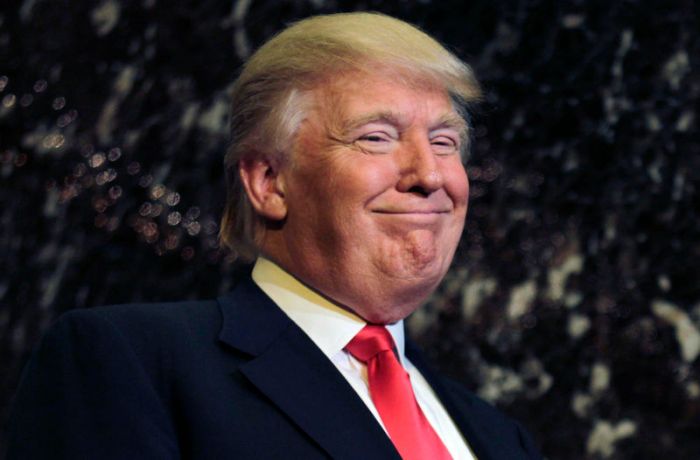
Guildenstern: I know. I know. But you were still sleeping and I was bored and the paper was blowing past. I grabbed it and thought, just once won’t do me any harm will it? It had a large picture of a man and even larger words saying, HE’S WON! His name was Donald Trump. The smaller words said he was going to be the next President of the United States.

Rosencrantz: Say that name again.

Guildenstern: Donald Trump. His name was Donald Trump and he was saying that he was going to be president for everybody, and that now was the time for everybody to come together and love each other, or something like that. Maybe not love, but you know, like each other a lot. He was going to make America great again for Americans. He didn’t mention anybody else.

Rosencrantz: Oh dear.

Guildenstern: What’s wrong?

Rosencrantz: Don’t you see Guildenstern? This is why you thought the heavens were out of alignment last night and why you awoke with a chill wind blowing around you. Last night you believed what you were told. You might not have consciously thought so, but deep down in your soul, a little flame came to life. And then this morning you awoke, and nothing had changed. You’re still here on this bench. I’m still here next to you. That nothingness was cold, hard reality hitting you in the face.

Guildenstern: No. Is it not worth believing, just to suspend disbelief? The world might get better. There’s always hope.

Rosencrantz: That’s true my friend, there is always hope. But hope means different things to different people. A rich man’s hope, such as Mr Trump’s, is not the same as yours or mine. I may be wrong. It’s possible. But it would take a very great man to step away, entirely, from the shadow of his towers of gold and not look back to help the likes of you and me.

Guildenstern: Yes. I see. He has his empire to protect, after all. His legacy of a lifetime gathering acquisitions, he wouldn’t want that to crumble. Perhaps Rosencrantz that’s what he really means about making America great again: What’s great for America is great for him, too! But it ain’t necessarily so for us.

Rosencrantz:  Indeed. Feeling warmer now?

Guildenstern: I think I am. (pause) It wasn’t a bad dream was it?

Rosencrantz: No.


Warwick McFadyen is a freelance writer and editor

Remembering Rilke

rmrilke

By Warwick McFadyen

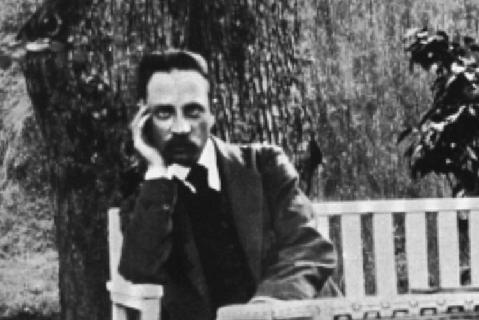
On December 4, 1875, Rene Karl Wilhelm Johann Josef Maria Rilke was born. The 90th anniversary of his death occurs next month – on December 29. He was known then as Rainer Maria Rilke – a poet who had sublimated his life to his calling. If he could not create, then life was barren – for life was art and art was life.

Four years before his death, he finished his masterpiece, The Duino Elegies. It was 10 years in its creation, and was published the same year as T.S. Eliot’s The Wasteland and James Joyce’s Ulysses, making 1922 something of a year of miracles in literature.

In his end days, he had said to his nurse Frau Wunderly, “Never forget, dear friend, life is a glory.”

It is easy to forget, Rilke. Too easy. Perhaps one should turn off the world, simply pull the plugs, let the batteries die, watch the screen lights fade. For a while. (I know, I’m communicating that thought with the batteries full, the laptop plugged in, the internet connected, the screen glowing towards me.)

Life is necessary with these things, I acknowledge that, but a glory? Rilke was always going deeper with his words, into the dark woods, through the light-draped leaves, into the stillness that has always been there, will always be there. Where the soul is both shadow and sun.

Eight days before his death he wrote to Jules Supervielle, that he was “gravely ill, painfully, miserably, humbly ill. … I think of you, poet, friend and in so doing I think still of the world, poor broken fragments of a vase that remembers being of the earth.”

If this reads as a hearkening back to a utopian state of existence that was, in effect, illusory then it also goes the heart of his creative impulse. We are one – all creatures, all life, all elements – that endure. In the mire lies a memory that was/is a part of us, which would reside in us if we let it. Art was the channel to its unlocking. It was the door that opened to seeing what really is. So Rilke believed.

He took the reader there in The Panther

His vision, from the constantly passing bars,
has grown so weary that it cannot hold
anything else. It seems to him there are
a thousand bars; and behind the bars, no world.

As he paces in cramped circles, over and over,
the movement of his powerful soft strides
is like a ritual dance around a centre
in which a mighty will stands paralysed.

Only at times, the curtain of the pupils
lifts, quietly–. An image enters in,
rushes down through the tensed, arrested muscles,
plunges into the heart and is gone. 

And in The Eighth Elegy, the ending of which is:

Who formed us thus:/That always, despite/Our aspirations, we wave/As though departing?/Like one lingering to look,/From a high final hill,/Out over the valley he/Intends to leave forever,/We spend our lives saying goodbye.

In 1925, a year before he himself said his final goodbye, Rilke wrote: “It is our task to imprint this temporary, perishable earth into ourselves so deeply, so painfully and passionately, that its essence can rise ‘invisibly’ inside us. We are the bees of the invisible. We wildly collect the honey of the visible, to store it in the great, golden hive of the invisible. The Elegies show us at this work …”

In times such as these, where the world is both global village and fragmented societies and interests, where the arc of progress is smashed flat on the anvil of hate-filled ideologies, it can be an act of survival to step back into Rilke. For a while. The world does not go away, of course. But, for a small time, another opens.

From the First Elegy:

Who, if I cried out, would hear me among the angels’ hierarchies?
and even if one of them pressed me suddenly against his heart: I would be consumed in the overwhelming existence.
For beauty is nothing but the beginning of terror,
which we still are just able to endure,
and we are so awed because it serenely disdains to annihilate us.
Every angel is terrifying.

In this era of mass distraction, Rilke’s words can return to us what we can no longer truly, divinely, spiritually, hear or see. Ourselves.

Warwick McFadyen is a freelance writer and editor